Wednesday, March 21, 2012

On the Nature of Things- the complete suite (so far)

Abductor Pollicis, 2012  23"x30" inkjet print from Wet Collodion negative


The words text and texture share a common latin root- TEXO- to weave; to braid together; to construct with elaborate care.
SYN. see LIE, 2012  22" x 30" inkjet print from Wet Collodion negative
This surprising, yet intuitively clear bond of meaning, serves as the central metaphor for this suite of photographs. Language and sensation- the textual and the textural- are processes of pattern perception. Meanings are woven from words just as lived experience is interlaced with bodily feeling. To me, the hand-made, physical photographic image is the ideal way to express how concepts have a tactile presence because they are woven, because they are stitched together from what Barthes calls a “tissue of signs.”
 
the Catholic, 2012  22" x 30"  Inkjet print from Wet Collodion negative
The title, On the Nature of Things, is derived from an epic philosophical poem written in the 1st century BC by the Roman writer Titus Lucretius Carus, as an attempt to dispel superstitious beliefs in the supernatural and the consequent fears of death, by articulating a philosophy of the natural world then known as Atomism.  Over 2000 years ago, this philosophy uncannily presaged much of the work of contemporary scientists working in the fields of quantum physics. 
Atomism, 2012   22"x 30" inkjet print from Wet Collodion negative

 
The work was controversial when it was first written, more so when it was re-found and translated during the Renaissance, and it stands today as an eloquent testament to the dangers of dogmatic fundamentalism.  
Egyptians Jerusalem, 2012  22"x30" inkjet print from Wet Collodion negative
 
With this work, I am making a statement about the beauty of mutable meanings.  Just as our minds and bodies are composed of atoms that were recently (and will soon be again) elsewhere in the universe, our concepts and thoughts will spread, evolve, and recombine in an infinitely complex, woven pattern, with no pre-set goal or meaning.  
Crease, 2012  22"x 30" inkjet print from Wet Collodion negative
This is the central message of all existentialist, post-structural, and post-modern thought.  This idea brings anxiety to the mind of a fundamentalist; it brings peace to mine.  
Mare Tranquiliatus, 2012   22"x 30"  inkjet print from Wet Collodion negative
I work in an antiquated, hand-made photographic process called Wet Plate Collodion, because I think it is uniquely suited to expressing these ideas.  Every image made with this process is a balance of the orderly organization of information through the glass lens of the camera, with the unpredictable and unavoidable chemical and physical randomness in the plate that records the image. 
CYCL,  2012   22"x30" inkjet print from Wet Collodion negative
By photographing degraded reference texts, plaster molds, and other materials that record the physical actions taken upon them, my goal is to make images of undeniable and unashamed beauty, that speak of the deep connection between ideas and their physical manifestation.
Ruminate, 2012  22"x30" Inkjet print from Wet Collodion negative

Fascia, 2012  22"x30" inkjet print from Wet Collodion negative
 All images at 22" x 30" are in editions of 5, 11"x14" in edition of 10

Wednesday, March 14, 2012

Video portrait of me on Youplusdallas.com

Oh, this is simultaneously thrilling and horribly embarrassing.  (I really have to get over my uncomfortableness with self-promotion!)

The experience was actually quite fun- Heather Child, Seth Thorpe, and Brandon Carmichael from Youplusdallas.com came to my studio a few weeks ago and did this piece.  They were fantastic, we all had a great time doing it.

I'd LOVE to be able to post the video embedded, but I'm going to have to figure a way around Google's limitations on that....

Here is the link.  Please enjoy!

http://www.youplusdallas.com/stories/meet-photographer-scott-hilton#

Sunday, February 19, 2012

On the Nature of Things, March 10 2012 500X Gallery

One of the trappings contemporary art that I try to avoid (like career advancement, ha ha) is the tendency of artist to make their process very opaque.  Work is presented and discussed as if the ideas emerged whole, exactly as you see them in their current state.  Artists, gallerists and curators all have an investment in this opacity because it helps to make the work seem somehow purer, and the artist more heroic.  To reveal that the thinking process behind the work is sometimes messy and convoluted, is to raise questions of NOT being a genius.

I believe this has a lot to do with the scourge of over-vocabularized artist statements.

My whole impetus to do this blog was as a way to get over the desire to hide behind an opaque wall of language.  I can do it as well as the next MFA-holder, but I also hate it. 

I've noted that my creative processes go in a certain rhythm of tension and release- at times tight, at other times loose.  Understanding which time is which can be challenging, and requires a sensitivity to my own particular needs and abilities, as I am working.  But my pattern of conceptualization seems to go something like this-
  • I do things.  I make things, aimlessly.  I mess around and fuck up and get mad and berate myself for not having a clean idea.
  • I chill out, and notice patterns in what I am doing, thinking about, and making.
  • I have a "flash" realization of the underlying structure of what I have been doing.
  • I go back into making things, but with a clearer sense of purpose and direction.
It's not always that clean and clear but as I look back, even to my undergraduate days, it's the same pattern happening over and over.  Not all the "flash" realizations are good, and sometimes the crap I am making along the way is just crap.

I had been planning on doing a landscape-based project using my portable darkroom, but a nasty gust of wind tippled my whole operation over last fall, and I had to face the fact that I just was not ready for that (though I am still tinkering with the portable operation and hope to have another version running this May).

So- it was back into the studio for me.  So, I started photographing books and pushpins and other random materials.  Shooting things in this kind of "frontal" style has been something I've done for twenty years or more, almost like doing copy-work.  It's not wholly inappropriate, as the Wet Collodion process was common as a graphic-arts reproduction technique for well into the 20th century, long after dry plate and flexible film had usurped it as the field-photographic method of choice, for very good reasons.


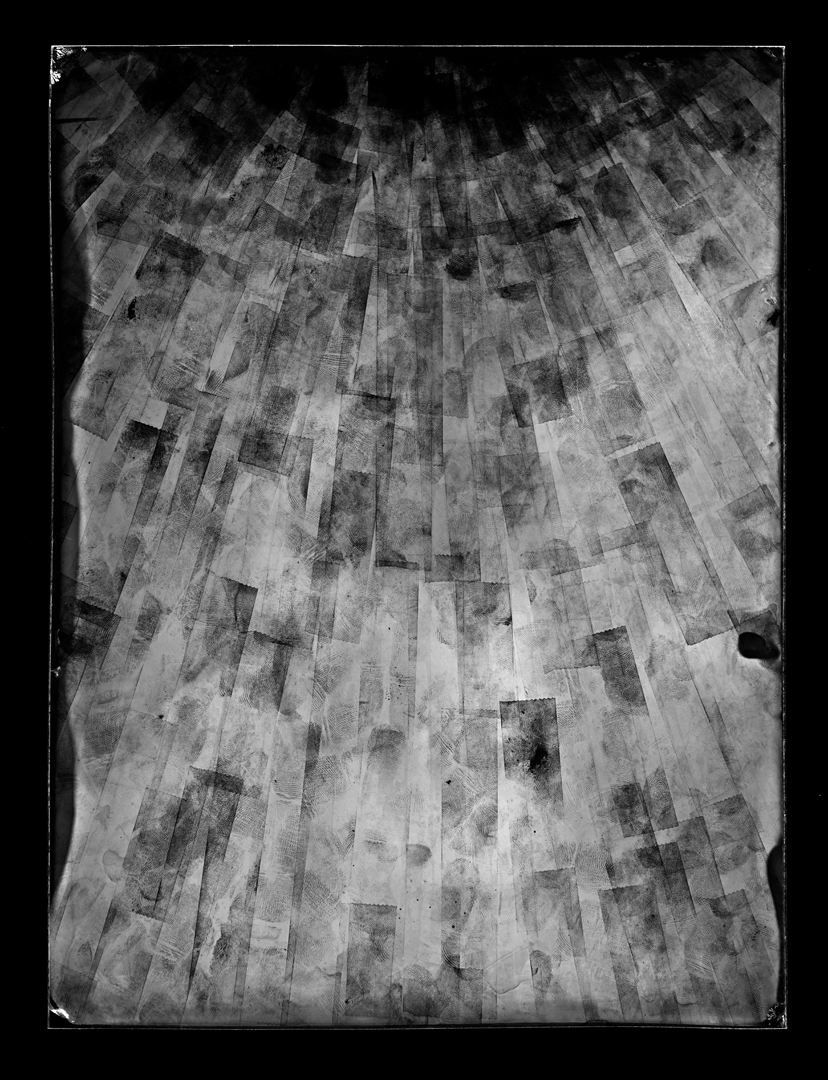
Shortly after I shot this image of the screen-door material, I got all excited about the idea of working with scotch tape, glass, an other semi-transparent materials, but in a way that they "recorded" the impressions of my working with them, by leaving fingerprints on the materials that would show up in the image.  Using powdered graphite, I had fun making this one-


This was all happy and everything, and I thoroughly enjoyed it.  But I still had no idea what was to tie all this together.  It made sense on some level, but my thinking on it was basically like a manipulating a bag of marbles.  Books, fingerprints, copywork, transparency... jumblejumblejumble.

The "flash" came to me when I realized that the terms text and texture were too similar to not be related, somehow.  Mr. Google was pretty quick with an answer-

TEXO- latin, to weave; plait (together); construct with elaborate care.

Holy Shit!


Writing and language is a weaving of meaning...   Roland Barthes from The Death of the Author- "the book itself is only a tissue of signs"...  a woven fabric is the most luxurious of textures, and a beautiful way to define the very concept of texture and the sense of touch in general... my whole attraction to the wet collodion process is deeply tied to the fact that it can only be done with elaborate care...

It's hard to express how this conception hit me... I felt it physically.  It immediately made sense to me why this had made sense even when I didn't understand it- the physical photographic image is the most ideal way to express how concepts have a tactile presence because they are woven...


This realization really sent me off, and I'm still running on the energy of that single, bomb-like flash of thought.

The title of the show, On the Nature of Things, is another matter altogether and deserving of it's own post.

Tuesday, January 10, 2012

A new project opening Sat Jan 14

Chris Tinnen and I have been collaborating on a project that will open at 500X on Saturday Jan 14- the Society for Olfactory Preservation.

The Society for Olfactory Preservation: A Manifesto
We, the members of the Society for Olfactory Preservation, or SOP, wish to present a few specimens of some of the most celebrated historical odors, which we have painstakingly kept intact for the benefit of humankind.  We believe that the tyranny of the visual and textual has overtaken the most significant of all human senses for the most accurate understanding of our history, that is, the sense of smell.  It is a well-known fact of science that the olfactory sense is the one most tied to memory.  To truly experience these pivotal historical moments, it is imperative that one imbibes through the sensitive organ of the nose.
The odors that you will be privy to inhale have been preserved in their original inviolate forms through the centuries.  Members of our elite society have been meticulously collecting these samples for hundreds and even thousands of years with the knowledge that future generations will apprehend these historic moments most completely upon experiencing the exhibit.  We advise that you approach each specimen with some trepidation as the intensity of the scent concentrate will transport you to another time and place, and this may prove disorienting.  Ladies may wish to have a gentleman present to aid her if she should faint.

(Giving credit when it is due- wife Linda wrote the manifesto after listening to Chris and I ramble on)

The idea originally came up a few years ago- Chris and Lupita Tinned were over at Linda's and my house a few years ago and some ideas were flying around the room, and it just sort of came to Chris and I almost spontaneously- The Museum of Smell - and we looked at each other and said, "We have to do this."  It's about four years later, (maybe five) but here is the first incarnation.

We're installing on Friday.  Chris is making the pedestals (which will probably be the best pedestals ever made) and I have been working on the "Interactive Olfactory Dispensers" which, oddly enough, look a lot like little cameras.

Monday, December 5, 2011

Some commissioned work- Gibson Guitar

My good friend Chris Grooms- an English professor at Collin College who also happens to be an amazing guitarist.  He's one of the world's foremost experts in traditional Welsh folk music.

This is one of the prize guitars from his personal collection- one of the last truly hand-made Gibson acoustics from the 1920's.


Wetplate is not very sensitive to yellow, so the guitar body ends up looking much darker than it did in person, but I love how that made the whole body have the thin outline around it from the edging.


Tintypes record everything backwards, horizontally, so the writing comes out reversed.  The letters are actually mother-of-pearl inlay.  This guitar is beautiful.   It was a pleasure to get the chance to photograph it.

 Chris also snapped a few pictures as things were progressing-


The general state of my studio.  Note the foamcore softbox!


Coating collodion on the plate, letting the excess pour back in the bottle


One of the true magical moments of the process- seeing the image come up in the fix.


Linda and I inspecting the plate in the first wash.


A good way to spend an afternoon.


Sunday, December 4, 2011

Pretiosissimi Sanguinis

An edition of images I made last week for including in the 500X Holiday Sale.

Pretiosissimi Sanguinis- 1 through 4


The title is from "Litaniae pretiosissimi Sanguinis Domini Nostri Iesu Christi", or "Litany of the Most Precious Blood of Our Lord Jesus Christ."  A litany that may be read in Catholic services, it dates from 1960.


I'm not Catholic, but I have a great respect for the power of Catholic symbolism.  The concept of the Eucharist - the ritual transformation of the simple matter of bread and wine into the the body and blood of Christ, to then be ingested as a means of communing with the divine - is fascinating to me and I can't say exactly why.  As a non-believer I can't follow the belief that the bread and wine are literally transformed in the process of consecration- but I am also somehow envious of those who do believe it.  To literally ingest your savior seems like a kind of intimacy that would feel incredibly powerful to those who do.


Perhaps I am just a spiritual tourist and it's not right for me to dabble with other people's sacred rituals, even in so oblique a fashion.  But I do find the symbolism of the Catholics very deep and resonant.  After two-thousand odd years of practice, they did do a few things right.


Saturday, November 26, 2011

Mind is Perpetual Motion - Its Symbol is the Sphere

This large shiny plastic ball was sitting by the side of a busy street about a year ago- I think it was a giant Christmas tree ornament hanging from a tree branch.  I shot this series of plates as part of an idea to present multiples, presented together to highlight the process variations and chemical wierdnessess.